Teeth Shifting After Tooth Extraction: Timeline and What to Expect
Written & Researched By
Editorial Team · product research desk
Sources: ADA guidelines, Mayo Clinic, PubMed, peer-reviewed dental literature
Published: September 7, 2026
Affiliate Disclosure: Some comfort-product links below are affiliates. If you buy through them, the editorial desk may earn a commission at no extra cost to you. See our full disclosure and How We Make Money.
Short answer: Adjacent teeth can slowly tip or drift toward an empty extraction space. Measurable movement has been reported within about 10 days in some orthodontic studies, and the space can keep changing for months. This is not the same as the socket hole closing. Wisdom teeth are a different situation from a functional molar, premolar, or front tooth. This page cannot tell you whether your teeth are moving, and it cannot tell you what replacement, if any, is right for you.
JawPainAfterToothExtraction is an editorial desk. We compile published dental guidance, manufacturer specs, and community consensus. We do not run an in-house lab or a test fleet, and we do not claim we personally treated patients. This is a timeline and planning note — not an alignment diagnosis and not an Amazon “space maintainer” shopping list.
Listing check: Confirm a sports mouthguard or “space maintainer” search card is not a dentist-made appliance for your gap. Amazon retainers, boil-and-bite guards, and generic space-maintainer toys are not a substitute for a chairside plan. If you only need first-week comfort, look for a jaw ice wrap or an elevated pillow — not a DIY orthodontic kit.
Early recovery is about the clot, swelling, and pain. Later questions are quieter. Will the gap stay? Will the next tooth lean? Will chewing feel uneven? Those questions are common, and the honest answers depend on which tooth came out, your age, crowding, and whether a replacement is planned.
Not medical advice: This article is for general education only. It is not a diagnosis, treatment plan, or promise that any option will prevent movement, relieve jaw pain, or restore your bite. Only the dentist or oral surgeon who knows your mouth can evaluate your situation. If a bite change is still there after swelling should have dropped, skip DIY retainers and call the dentist.
Why Teeth Can Move After an Extraction
Teeth are not bolted in place. Each tooth sits in bone and is held by a periodontal ligament, a thin connective-tissue sling that allows tiny daily movement. Chewing, lips, tongue, and the neighboring tooth all push and counter-push. When that balance is intact, the tooth stays roughly where it is.
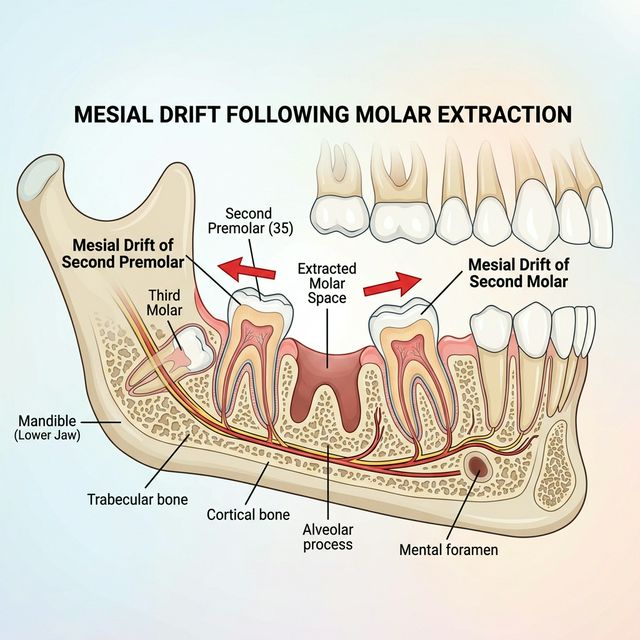
Remove one tooth and the contacts change. The tooth in front and the tooth behind no longer have the same neighbor to lean against. The tooth above or below no longer meets a partner when you bite. Over time, those neighbors may:
- Tip toward the gap (the crown leans more than the root)
- Drift bodily into the space
- Rotate slightly
- Super-erupt, meaning the opposing tooth may slowly come farther out of the socket because nothing stops it
Orthodontists call the unforced version of this physiologic drift. It is the same idea as teeth settling after an extraction done to make room for braces, except here the extraction was for decay, fracture, infection, or another dental reason, not for alignment.
A 2019 study in Scientific Reports followed patients after maxillary first-premolar extractions. The adjacent teeth tipped and moved toward the space, and the gap got smaller. Drift tended to slow with time. Younger patients and people with more crowding showed somewhat more movement in some measurements, though the authors described those age and crowding effects as limited. That study looked at planned orthodontic extractions, not every kind of tooth removal, so it is a useful description of how teeth can behave, not a forecast for your socket.
How Soon Do Teeth Start to Shift?
The socket you can see and the teeth next to it follow different clocks.
A 2023 review in the Journal of Contemporary Orthodontics, citing work by Jiang and colleagues, reported that physiologic movement of individual teeth was detected as early as 10 days after extraction and was still detectable at 240 days. That is research on orthodontic extraction spaces, measured on models and scans. It does not mean you will see a new gap in the mirror on day 10.
A practical way to think about the first year:
| Time after extraction | What is usually happening | What you might notice |
|---|---|---|
| Days 1–14 | Soft tissue heals; the blood clot organizes; neighboring teeth have barely had time to move | A hole in the gum, soreness, swelling. Any “shift” you feel is often swelling or a changed chewing habit, not a tooth walking into the space |
| Weeks 2–8 | Gum tissue covers more of the socket; early drift can begin on imaging or models | Food traps more easily. Floss may catch. The space can look smaller because gum is filling in |
| Months 2–6 | Bone remodeling continues; drift, if it occurs, is easier to measure | A tighter contact, a tooth that looks slightly tilted, or a bite that meets differently |
| Months 6–12+ | Ridge width and height keep changing if the site is left unrestored; opposing teeth may slowly extrude | A visible lean, a new food trap, or uneven wear on the remaining teeth |
The Scientific Reports premolar study reported an average physiologic-drift observation window of about 82 days. A review of that work described maxillary first-premolar spaces shrinking by roughly 0.8 mm per month in that sample, on the order of 4 mm over 6 months. Those numbers come from a specific age group and a specific tooth. A lower first molar in a 55-year-old is not the same case.
If someone tells you teeth “never move” after an extraction, that is too absolute. If someone tells you they always collapse in two weeks, that is too absolute as well.
Socket Closing Is Not the Same as Teeth Shifting
This mix-up causes a lot of late-night searching.
After a tooth comes out, you are looking at an extraction socket: a hole in gum and bone. Soft tissue typically grows over the opening across a few weeks. Bone fills from the bottom over months. That process is described in our day-by-day recovery timeline and in the healing-stages guide. The hole looking smaller is expected.
Teeth shifting is a different event. The neighboring crowns change position. The contact point moves. The bite on that side feels “off” even after the gum looks closed.
You can have:
- A closed-looking gum and no obvious tooth movement
- A still-visible dimple and early tipping next door
- Both at once
Do not use a phone photo of the hole to decide whether a molar has drifted. That decision needs a clinical exam and, when your dentist thinks it is useful, X-rays or models.
Does Every Extraction Make Other Teeth Move?
No. Location and function matter more than the fact that a tooth is gone.
Wisdom teeth
Third molars sit at the back of the arch. For many adults they do not hold the bite together the way a first or second molar does. After wisdom tooth removal, people often worry that the second molar will tumble backward into the space. Some change can occur, especially if the second molar was already tipped against the wisdom tooth. Many people do not notice a bite change once swelling settles. That is one reason our molar vs. wisdom tooth comparison treats these extractions as different long-term problems.
Wisdom tooth recovery is still a real recovery. Pain, swelling, and jaw stiffness are common. Those short-term problems are not proof that the rest of your teeth are migrating.
Functional molars and premolars
A first molar, second molar, or premolar that you chew with is a load-bearing tooth. Take it out and the remaining teeth have a new job. Adjacent teeth may tip into the space. The opposing tooth may slowly erupt. Cleaning the new triangle of space gets harder, which can raise the chance of food traps and gum irritation later.
This is the setting where dentists most often talk about replacement planning, not because movement is guaranteed next week, but because an unrestored gap can become a harder restorative problem after months of drift and bone change.
Front teeth
An incisor or canine gap is obvious when you talk or smile. Neighbors can still tip, and the bite on the front teeth can change. Appearance and speech often drive the conversation sooner than they do after a hidden back-tooth extraction. See front tooth extraction recovery for the short-term side of that situation.
Multiple extractions
Removing several teeth in one area, or a full-arch clearance before dentures, changes the whole support system. Immediate dentures, when used, act as a covering and a space-holder while gums shrink. That process is covered in recovering from multiple tooth extractions. Expect the fit to change as healing proceeds. That is gum and bone remodeling as much as it is teeth sliding.
Bone Shrinks After Extraction, and That Changes the Neighborhood
Teeth move through bone. Bone also changes on its own after a tooth is gone.
The alveolar bone around a root exists to support that root. After extraction, that bone is remodeled. Classic work by Schropp and colleagues, widely cited in later socket studies, found that ridge width could fall by about half over 12 months, with about two-thirds of that change in the first 3 months. Later reviews in the periodontal literature describe horizontal loss in a wide range, often on the order of 3 to 4 mm on average, with the outer (buccal) plate losing more than the inner plate.
A 2023 paper in BioMed Research International summarizing earlier research described height loss of about 11% to 22% and width loss of about 29% to 63% over the first year, with a large share of ridge change in the first three months. Those figures are ranges across studies, not a personal prediction.
Cleveland Clinic notes that jawbone can shrink after tooth loss and that implants are one way clinicians try to preserve bone by replacing the root. Cleveland Clinic’s bone-graft overview explains that grafts are commonly used when bone volume is already low or when a future implant is planned. Our bone graft after tooth extraction guide covers socket preservation in recovery language.
Bone change does not mean your face will “collapse” after one molar. It does mean the ridge can narrow, the gum contour can flatten, and the neighboring teeth have a less stable wall to rest against. That is one reason replacement, if it is appropriate, is often discussed early rather than years later.
What Teeth Shifting Can Feel Like
Early on, almost everything feels different. Numbness fades. Swelling drops. You chew on the other side. Those changes can mimic a “shifted bite” for a week or two.
Later signs that are more about tooth position than about swelling include:
- Floss that used to snap through a contact now shreds or will not pass
- A tooth next to the gap looking longer, shorter, or more tilted in photos taken months apart
- Food packing in a new triangle that was not there at your two-week check
- A high or low spot when you close, as if one tooth meets first
- Cheek or tongue biting on a sharp new edge
- The opposing tooth looking closer to its neighbor’s chewing surface
None of those findings, by themselves, diagnose a problem. A high filling, a bone spicule, granulation tissue, or incomplete healing can feel similar. If something new appears after the first month, it is reasonable to ask your dentist to look, not to decide at home.
Can Shifting Teeth Cause Jaw Pain?
This site exists because jaw pain after extraction is common, and most of it in the first week is swelling, muscle fatigue, and the joint being held open during the procedure. That pattern is covered in how long jaw pain lasts and jaw stiffness.
A missing chewing tooth can add a second, slower problem. If you avoid one side for months, the other side does more work. The jaw muscles on the working side can fatigue. The joint can feel clicked or tired, which some people notice as jaw clicking. Stress and clenching can stack on top of that, as described in how stress affects jaw pain.
That is a possible mechanical story. It is not a diagnosis of TMJ disorder, arthritis, or nerve injury. Nerve-related symptoms after lower wisdom teeth or lower molars are a separate issue and need a clinician, not a timeline chart.
If jaw pain is getting worse after the first several days, or if your mouth opening is shrinking instead of improving, that is a reason to call, not a reason to assume the next tooth has already drifted.
First-Week “Shift” vs Months-Later Drift (Product Fit)
Amazon listicles collapse two different problems into one “buy a retainer” card. This desk splits them.
Days 1–14. A bite that feels “off” is usually swelling, numbness wearing off, or chewing on one side — not a neighbor walking into the gap. Comfort tools that match published aftercare (not alignment tools) include:
- A jaw ice wrap for the first 48 hours if your provider wants exterior cold — confirm the live title is a wrap, not a migraine mask. Buying criteria live in Best Ice Packs for Jaw Pain.
- An elevated pillow for the first nights so you are not sleeping flat on the extraction side. Type notes are in Best Recovery Pillows.
- Spoon-friendly meals so you are not grinding into the gap. Texture lists are in Best Soft Foods After Dental Surgery.
Weeks 6–12+. If a contact still feels new after the socket looks closed, that is a chair question, not a reason to order a boil-and-bite guard. Skip DIY. Book the exam.
Research cost ranges (not live Amazon prices, not a quote): Community and clinic fee surveys often put a removable flipper in the low hundreds of dollars, a tooth-supported bridge in the low-to-mid thousands per unit, and a single implant-plus-crown in a wider multi-thousand band depending on bone work. Confirm your office’s current fee sheet. Those numbers go stale; this page will not invent a sale price.
What Does Not Stop Teeth From Moving
Home routines help the socket. They do not glue the neighboring teeth in place.
Gentle salt-water rinses, a soft-food stretch, and avoiding straws protect the clot. They do not lock the arch. An alcohol-free rinse after the first day — if your dentist is fine with it — is hygiene, not orthodontics.
Chewing only on the opposite side for months can feel safer. It can also train an uneven bite. Returning to a balanced diet when your dentist says the site can handle it is part of recovery, not a trick to prevent drift.
Retainers, night guards, and “space maintainers” only help if they were made for that purpose and you wear them as directed. A sports mouthguard from a drugstore is not a substitute for a dental appliance designed to hold a space.
Do not push the neighboring tooth with your tongue, a finger, or a toothpick to “keep the gap open.” That can injure healing tissue and does not control physiologic drift.
When to skip DIY: If you are shopping Amazon for a “space maintainer,” clove packing paste, or a kit that promises to “hold the gap,” stop. Those cards are not a treatment plan. Call the office that extracted the tooth. Symptom triage for a socket that suddenly hurts more is in Dry Socket Symptoms.
Options Dentists May Discuss (Not a Menu You Should Self-Select)
When a functional tooth is missing, clinicians often talk about holding the space or replacing the tooth. Which option is even possible depends on bone, gum, the condition of the neighboring teeth, medical history, and cost. The following is a map of the conversation, not a recommendation.
Watch and reassess
If the missing tooth is a wisdom tooth, or if a replacement is already planned for a later date, the plan may be observation plus hygiene. Ask how soon they want to see you again and what signs should trigger an earlier visit.
Socket preservation or later bone grafting
A graft placed at extraction, or later, is meant to limit ridge collapse when an implant is being considered. Cleveland Clinic describes grafts as a way to rebuild volume before implant surgery. Grafts do not, by themselves, stop the next tooth from tipping. They address bone.
Dental implant
Mayo Clinic describes an implant as a metal post placed in the jaw to stand in for a root, later restored with a crown. Cleveland Clinic notes that implants can help with chewing and with limiting the sunken look that follows bone loss, and that healing often takes months. Immediate implant placement is sometimes possible and sometimes not. Infection, thin bone, and medical factors can push the timeline later. No article can promise that an implant will “lock” your bite.
Bridge
A tooth-supported bridge uses crowns on the teeth next to the gap. Cleveland Clinic’s comparison of bridges and implants notes that a bridge does not replace the root, so it does not preserve bone the way an implant is intended to, and that neighboring teeth must be prepared. The American Dental Association, as cited there, has noted that bridges often need replacement after a period of years. A bridge can fill a space and restore chewing. It is not automatically better or worse than an implant for every mouth.
Removable partial denture or flipper
A removable tooth can hide a front gap or hold some space while you heal. Fit changes as gums shrink. Immediate dentures after multiple extractions are a known example. Removable appliances help some people and annoy others. Cleaning around clasps takes care.
Orthodontics
If teeth have already tipped, an orthodontist may discuss uprighting them before a bridge or implant. That is a specialized plan, not a first-week recovery step.
Ask what happens if you wait six months versus a year. Ask what happens if you do nothing. Those questions belong in the chair. Our questions to ask before extraction list is a starting point.
A Conservative Timeline for Talking About Replacement
This is a discussion calendar, not a treatment schedule.
Before the extraction. If the tooth is a functional molar or a visible front tooth, ask whether they recommend a space-holding option, a graft, or a delayed implant consult. The preparation guide is about the first week. The replacement question is about the next year.
First two weeks. Focus on clotting, bleeding, and pain. Do not judge alignment yet.
One month. Soft tissue is further along. If a temporary flipper or partial was delivered, it may already need an adjustment as swelling falls.
Three to six months. This is a common window for “has anything moved?” photos, bite checks, and implant-site imaging if that path is under consideration. Bone change is still underway.
After six months. An unrestored functional gap has had time for more drift and more ridge change. That does not make replacement impossible. It can make it more involved.
Your dentist may use a different calendar. Follow that one.
When to Call Your Dentist About Possible Shifting
Call for an exam, rather than waiting for the next cleaning, if you notice:
- A tooth next to the gap that looks newly tilted, loose, or painful to bite on
- A bite that meets on one tooth first and will not “find” the old position
- Food traps that appeared after the first month and will not clear with normal brushing
- Jaw pain or stiffness that is new or worse after the extraction site itself has calmed
- Speech changes after a front-tooth extraction that are getting more noticeable, not less
- A temporary denture, flipper, or night guard that suddenly rocks or sore-spots after it used to fit
Seek urgent care for spreading facial swelling, trouble swallowing or breathing, fever with worsening socket pain, or uncontrolled bleeding. Those are medical and dental emergencies, not alignment issues. See infection warning signs and when to worry about swelling.
Frequently Asked Questions
Will my teeth move after a wisdom tooth extraction?
Many people do not notice lasting bite change after third-molar removal. The second molar can change position in some cases, especially if it was already leaning. Short-term jaw stiffness is much more common than obvious drifting. Ask your surgeon what they expect for your X-rays.
How fast do teeth move into an extraction gap?
In orthodontic extraction studies, movement has been recorded by about 10 days and can continue for many months. Visible lean or a new food trap, when it happens, is more often a months-long change than an overnight one.
Can I prevent shifting with a retainer I already own?
Only if that retainer still fits and was designed to hold those teeth. An old clear aligner or a night guard from another problem may not hold an extraction space. Do not force an appliance over a healing socket unless your dentist told you to.
Does a bone graft stop neighboring teeth from tipping?
A graft is aimed at ridge volume. It does not replace the missing tooth’s crown or contact point. Tipping is a separate mechanical issue.
If my bite feels off after one week, have my teeth already shifted?
Usually not in a lasting way. Swelling, a high socket, muscle guarding, and chewing on one side can all change how the teeth meet. Recheck the question after the first two weeks, or sooner if pain is escalating.
Can shifting after extraction cause headaches or ear pain?
Uneven chewing can fatigue jaw muscles, and muscle fatigue can be felt in the temple or near the ear. Headache and ear pain after extraction have several causes. Do not assume the next tooth has already moved.
Key Takeaway
A missing functional tooth can allow neighbors to tip or drift, and the opposing tooth can slowly erupt. Research on orthodontic extraction spaces shows that movement can start within days and continue for months, while the socket hole closing is a different process. Wisdom teeth are not the same problem as a chewing molar or a front tooth. Bone at the site also narrows, especially in the first three months, which can make later replacement more involved. Home care protects healing. It does not lock the arch. Ask your dentist what they recommend for your gap, and treat this page as background, not a plan.
Medical disclaimer: JawPainAfterToothExtraction.com provides general information about dental recovery. It does not provide medical or dental advice, diagnosis, or treatment. Nothing here is a substitute for an in-person evaluation. If you think you have a complication, contact your dentist, oral surgeon, or emergency services.
Written and researched by the JawPainAfterToothExtraction Editorial Team. Claims about timing and bone change are drawn from published dental research and institutional overviews. They are not a forecast for an individual patient. We are an editorial desk, not a dental clinic.
Sources: Teng et al., Scientific Reports (2019); Agarwal et al., Journal of Contemporary Orthodontics (2023) (citing Jiang et al. on early physiologic drift); Schropp et al., as summarized in PMC2967810; Hussain et al., BioMed Research International (2023); Cleveland Clinic, dental implants; Cleveland Clinic, dental bone graft; Cleveland Clinic, bridge vs. implant; Mayo Clinic, dental implant surgery.
Related Recovery Guides
- Dry Socket: Signs, Prevention & When to Call Your Dentist
- Dry Socket Symptoms: How to Know If You Have One
- Best Soft Foods After Dental Surgery
- Best Oral Rinses for Post-Extraction Healing
- What to Expect hub
- Recovery product hub
- Molar vs. Wisdom Tooth Extraction
- Bone Graft After Tooth Extraction
- Questions to Ask Your Dentist Before Extraction
- How Long Does Jaw Pain Last