When to Worry About Swelling After Tooth Extraction
Written & Researched By
Editorial Team · product research desk
Sources: ADA guidelines, Mayo Clinic, PubMed, peer-reviewed dental literature
Published: September 14, 2026
Affiliate Disclosure: This article contains affiliate links. If you purchase through our links, we may earn a small commission at no extra cost to you. This supports the editorial desk. See our full disclosure and How We Make Money.
Short answer: Aftercare swelling cards usually describe a peak around 24 to 48 hours, then a turn on day 3. A cheek that is still growing after day 3 — or swelling with high fever, pus, or trouble breathing — is the phone-call pattern those pages print, not a blog diagnosis. Follow your written card if it differs.
JawPainAfterToothExtraction is an editorial desk. We compile published dental guidance, manufacturer specs, and community consensus. We do not run an in-house lab or a test fleet, and we do not claim we personally treated patients. This page is a growing-after-day-3 call card plus an ice-then-call switch — duration lives on the calendar sibling — not a diagnosis page and not a “swelling-reduction kit.”
Listing check: Confirm this is a growing-after-day-3 call card plus an ice-then-call switch, not a duration calendar. A gel wrap is first-48-hour exterior cold — not a “swelling-reduction kit.”
Duration calendar sibling: How Long Does Swelling Last After Tooth Extraction?. First-day oozing: Bleeding After Tooth Extraction. Suture edges that look open: Stitches After Tooth Extraction. Inhale pressure next to a louder cheek: Smoking After Tooth Extraction. Limited opening that can sit next to puffiness: Jaw Stiffness After Tooth Extraction. Hub: Pain Relief.
Before you click a wrap (desk checklist)
- Is the cheek still getting bigger after day 3? That is a call, not a new Amazon kit. The duration bands live on how long swelling lasts.
- This page vs the calendar: this is the worry threshold. Peak-then-down language is already compiled on the sibling. Do not treat this card as a second timeline mill.
- Ice-then-call is a switch, not two products. Exterior cold for the first 48 hours if the sheet named it. A cheek that is still growing after the peak is an office question — not a second wrap.
- Gel wrap vs wedge: a jaw ice pack wrap is cheek coverage. A wedge is overnight loft. They are different cards. Ice form factors: Best Ice Packs for Jaw Pain.
- Research price: a reusable jaw wrap often sits around $10–$20; a single-piece wedge around $30–$50. Household freezer pack + stacked pillows are $0 extra if you already own them. Those are research bands, not a live quote.
What Those Sheets Call Usual Puffiness
Some swelling is the inflammatory language public aftercare pages print after tissue work. How loud it looks often tracks how much bone or flap work the card named.
Simple extractions (fully erupted teeth) may show only mild jawline puffiness.
Surgical extractions (impacted wisdom teeth or teeth that needed bone removal) often look louder — cheek, under-eye, or toward the neck — depending on the site the office named.
That is a calendar note on the duration sibling. This page asks a different question: did the arc turn, or is it still climbing?
Research snapshot: the turn those pages print
| Day | Language on public swelling cards | This call card |
|---|---|---|
| Day 0 | May stay quiet for a few hours | Start exterior cold only if your sheet named it |
| Day 1 | Building puffiness; mild stiffness can sit next to it | Still expected-band language |
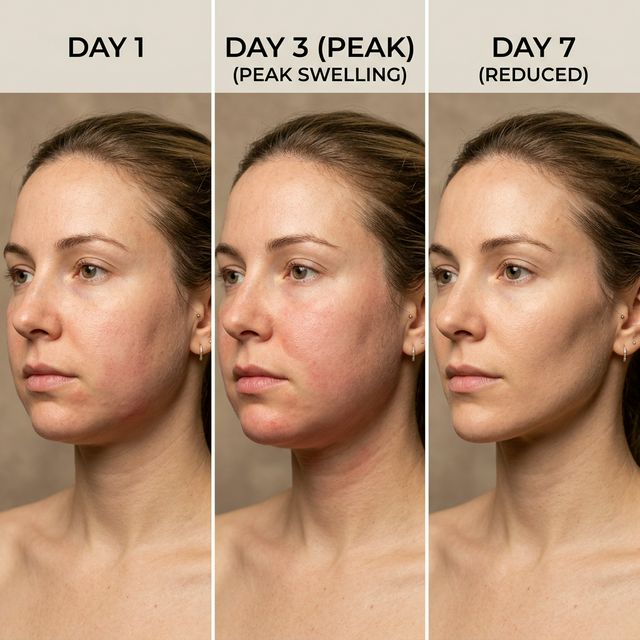
| Day 2 | Peak; face may look asymmetric | Loudest usual day — still not a diagnosis |
| Day 3 | Should begin to ease | If it is still growing, call |
| Days 4–5 | Most visible puffiness fades | Growing or down-then-back is the call |
| Day 7 | Residual mild puffiness at most | A cheek that is still climbing is not this row |
Wisdom-teeth notes sometimes stretch the peak into day 3. Growing after that turn is still the call those pages print.
Ice-Then-Call (Comfort Habits, Not a Protocol)
You cannot delete swelling. Aftercare pages name habits that may make the peak less loud — comfort logistics, not a guarantee.
Exterior cold (first 48 hours)
If the sheet named cold: apply a jaw ice pack wrap or a cloth-wrapped pack to the outside of the face. The cadence those pages often print is 20 minutes on, 20 off.
Confirm the live title is a flexible gel / jaw wrap — not a migraine mask and not a sealed kit. Compare: Best Ice Packs for Jaw Pain and the hub Pain Relief.
Warm moist heat (after the peak — if the card switched)
After about 48 hours, many sheets switch to a warm, damp washcloth. Heat during the first 48 hours is the skip those pages print. Warmth does not replace a growing-after-day-3 call.
Overnight elevation
Sleep propped about 30 to 45 degrees for the first 2–3 nights if that matches the card. A single-piece wedge is optional if stacked pillows slide. Confirm loft in the 7- to 10-inch band. Station setup: How to Sleep After Tooth Extraction.
Written anti-inflammatory, if named
If the office wrote ibuprofen (or another anti-inflammatory) on the card, that schedule is theirs. This desk will not invent a dose.
When to Skip DIY and Call
Most post-extraction puffiness follows the peak-then-down arc on the duration calendar. These are the patterns public pages treat as a dentist (or ER) question — not a kit:
Still growing after day 3
The defining call on this page. Usual language is up, peak, steadily down. Bigger on day 4 or 5, or down-then-back, is an office question.
Fever at the number your card called a call-now
Low-grade warmth on day 1 is sometimes described as part of the inflammatory window. A high fever plus a growing cheek is infection language on those pages — still an office question, not a selfie label.
Spreading toward the throat or neck tightness
Difficulty swallowing or breathing with spreading swelling is emergency-department language on public aftercare pages. Do not wait for a wrap to arrive.
Pus or a persistent foul taste
Different from first-day blood-tinged saliva. Call. First-day oozing: Bleeding After Tooth Extraction.
Pain getting louder after day 3 along with the puffiness
Dry socket symptoms or infection language — still a phone call, not a kit. This desk is not adding a second dry-socket mill; use the already-published signs pages.
Numbness that outlasts the anesthetic window
Prolonged lip, chin, or tongue numbness plus a growing cheek is an evaluation question on those sheets. Numbness duration companion: How Long Does Numbness Last After Extraction?.
Swelling vs Dry Socket (Two Different Cards)
Swelling and dry socket signs are filed separately on public pages:
- Swelling — visible puffiness; inflammatory language
- Dry socket — empty-looking socket, exposed-bone language, intense radiating pain; often minimal external puffiness
Severe pain with little cheek fullness around day 3 to 5 is the dry-socket card, not this worry threshold. Do not self-label from a photo.
What an Office Visit Usually Checks (Logistics, Not a Script)
If you go in for a growing cheek, public clinic pages typically describe an exam of the site, a temperature check, lymph-node feel, and an X-ray if a fragment is suspected. Antibiotics or drainage are their decisions. This desk will not invent a prescription.
Tagged Amazon cards (confirm the live titles)
| Listing | Research price band | What to confirm before you click |
|---|---|---|
| Jaw ice pack wrap | About $10–$20 (research) | Live title is a flexible gel / jaw wrap for exterior cold — not a migraine mask, not a “swelling-reduction kit” |
| Kolbs-style bed wedge | About $30–$50 (research) | Live title is a single-piece wedge in the 7–10 inch loft band — not a travel U-pillow |
| Tagged jaw-wrap search | Research band varies | Use this if the live DP title drifted to a sleep bundle or a sealed kit |
Desk shortlist (not a face trial): If a cloth-wrapped household pack and stacked pillows already hold the first 48 hours, skip the cart. We did not measure cheeks. A wrap is cold. A wedge is loft. If the live title is a “swelling-reduction kit,” stay on the call card.
When to skip DIY: Skip diagnosing an infection from a selfie. Skip heating a fresh site. Skip waiting for a wrap to ship if the cheek is still growing after day 3 — call. Difficulty breathing or swallowing is ER language — not an Amazon cart.
Frequently Asked Questions
Is day-2 puffiness a reason to call?
Usually not by itself. Those cards treat day 2 as the peak. Growing after the day-3 turn is the call.
Should I ice a cheek that is still getting bigger on day 4?
Ice does not replace the phone call. Comfort habits are first-48-hour language on most sheets. A climbing cheek is an office question.
How is this different from the swelling-duration guide?
How long swelling lasts is the peak-then-down calendar. This page is the worry threshold.
When should I go to the ER?
Spreading swelling with trouble breathing or swallowing is emergency-department language on those pages.
Key Takeaway
This is a growing-after-day-3 call card plus an ice-then-call switch — not a second duration calendar. Confirm gel wrap vs kit before you click. Call if the cheek is still climbing after day 3.
Related Reading
- How Long Does Swelling Last After Tooth Extraction?
- Bleeding After Tooth Extraction
- Stitches After Tooth Extraction
- Smoking After Tooth Extraction
- Jaw Stiffness After Tooth Extraction
- Pain Relief
- How to Sleep After Tooth Extraction
Written and researched by the JawPainAfterToothExtraction Editorial Team. Sources: ADA guidelines, Mayo Clinic, peer-reviewed dental literature. We are an editorial desk, not a dental clinic.
Sources: American Dental Association; Journal of Oral and Maxillofacial Surgery; Cleveland Clinic.