Bone Graft After Tooth Extraction: What to Expect
Written & Researched By
Editorial Team · product research desk
Sources: ADA guidelines, Mayo Clinic, PubMed, peer-reviewed dental literature
Published: March 31, 2026
Short answer: A bone graft placed at the time of tooth extraction — called a socket preservation graft — prevents the jawbone from shrinking after the tooth is removed. Without it, the bone that once supported your tooth resorbs significantly in the first 3–6 months. A graft maintains enough bone volume to place a dental implant later. Recovery from a grafted socket takes 4–6 months before implant placement is possible.
If your dentist or oral surgeon mentioned a bone graft alongside your extraction, you may be wondering what it involves, whether it’s really necessary, and how it affects your recovery timeline. This guide explains everything clearly.
Why Does Bone Shrink After Extraction?
The bone surrounding a tooth root — called the alveolar bone, exists specifically to support that tooth. Once the tooth is removed, the body has no biological reason to maintain that bone. Resorption (bone loss) begins within days of extraction and continues for months.
Research published in the Journal of Oral and Maxillofacial Surgery shows that within 12 months of extraction, the socket can lose up to 40–60% of its original width and 30–40% of its height. This loss is most rapid in the first 3 months.
For patients planning a dental implant, which requires adequate bone volume to anchor securely, this bone loss can make implant placement difficult, more expensive, or sometimes impossible without a larger bone regeneration procedure later.
What Is Socket Preservation?
Socket preservation (also called ridge preservation or a socket graft) is a straightforward procedure done at the same appointment as your extraction:
- The tooth is removed
- The socket is cleaned and any infection is addressed
- A bone graft material is placed into the empty socket
- The site is covered with a collagen membrane and/or sutured closed
The graft material acts as a scaffold that:
- Prevents socket collapse, maintains the walls of bone around the empty space
- Stimulates new bone formation, your body gradually replaces the graft material with your own bone over 4–6 months
- Preserves the shape of the ridge, maintains enough width and height for implant placement
What Is the Graft Material?
Several types of graft materials are used in socket preservation:
| Type | Source | Common Usage |
|---|---|---|
| Allograft | Processed human donor bone | Most common in the US |
| Xenograft | Processed bovine (cow) bone | Very common, well-studied |
| Alloplast | Synthetic (hydroxyapatite, TCP) | Fully artificial option |
| Autograft | Your own bone (from another site) | Gold standard, less common for sockets |
All graft materials are extensively processed and sterilized. Your surgeon will select the type based on clinical preference, site characteristics, and your medical history. If you have concerns about the source of graft material (for religious or other reasons), ask your surgeon about alloplast options.
Is a Bone Graft Always Necessary?
No, not every extraction requires a graft. Socket preservation is most commonly recommended when:
- An implant is planned at that site in the future
- The extraction socket has thin walls (common at upper front teeth or lower wisdom teeth)
- Infection or bone loss was already present around the tooth
- Multiple adjacent teeth are being extracted (more significant ridge loss)
If you’re not planning an implant and the remaining teeth don’t need the ridge preserved (e.g., you’re getting a bridge or partial denture instead), a graft may not be necessary. Discuss your long-term tooth replacement plan with your dentist before the extraction. An unrestored functional gap is also where dentists discuss neighboring teeth tipping or drifting over months.
What Does the Recovery Feel Like?
Recovery from a grafted socket is similar to a standard extraction but with a few differences:
First 24–48 hours: The site feels the same as a regular extraction, soreness, swelling, and some oozing. The collagen membrane or sutures at the surface are normal and will dissolve.
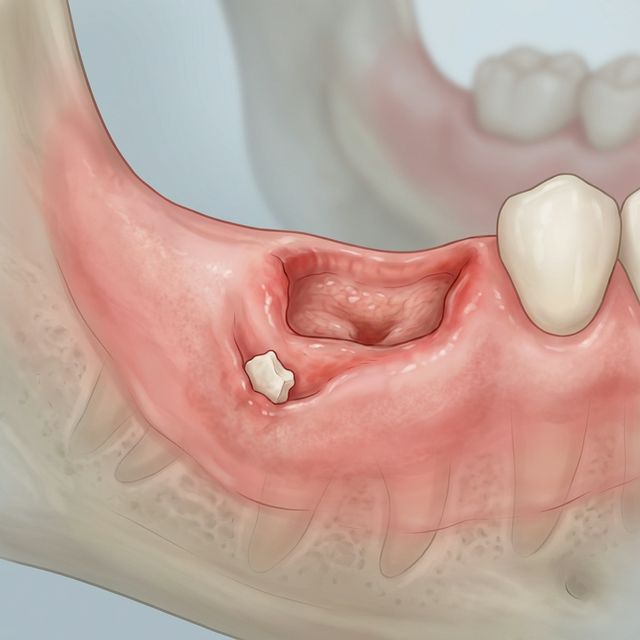
Week 1–2: The graft material is in place and the body begins forming a blood supply around it. You’ll notice the socket doesn’t have the same “hole” appearance as a non-grafted extraction, the graft material fills the space.
What looks different: Some white or cream-colored material visible at the top of the socket is normal, that’s the graft. It should not be picked at or disturbed.
Month 1–4: The graft material is gradually replaced by new bone. During this period the socket looks and feels increasingly normal from the outside, even as bone regeneration is happening internally.
Month 4–6: Healing is assessed with an X-ray. Your surgeon evaluates bone density and volume to determine if enough new bone has formed for implant placement.
Recovery Timeline
| Timeframe | What’s Happening |
|---|---|
| Day 0–3 | Initial healing, blood clot forms around graft |
| Week 1–2 | Soft tissue closes over the graft |
| Month 1–3 | Rapid bone regeneration phase |
| Month 4–6 | Bone matures and densifies |
| Month 4–6+ | Implant placement assessment |
Standard Post-Graft Care
The care instructions for a grafted socket are nearly identical to a standard extraction, with a few additions:
- Don’t rinse forcefully for 48 hours, same as any extraction
- Don’t disturb the graft material visible at the surface, avoid poking it with your tongue or fingers
- Salt water rinses starting 24 hours after surgery, gentle, not vigorous
- Soft foods for the first week
- No smoking, smoking severely impairs graft integration and bone formation
- Keep follow-up appointments, your surgeon needs to monitor healing
How Long Until You Can Get an Implant?
Implant placement timing after socket preservation typically ranges from 4 to 6 months, though this varies based on:
- The tooth location (front teeth often heal faster than back molars)
- The graft material used (some integrate faster than others)
- Your overall health (diabetes, smoking, and certain medications slow healing)
- X-ray and clinical assessment at your follow-up
Your oral surgeon will take an X-ray around the 4-month mark to evaluate bone density. If the graft has integrated well, implant placement can proceed. If more time is needed, they’ll advise waiting another 4–8 weeks. For a week-by-week look at the first months, see our bone graft recovery timeline.
What If You Don’t Get a Graft Now, Can You Add Bone Later?
Yes, but it’s more complex and expensive. If significant bone loss has occurred before implant planning, larger block grafts or sinus lifts (for upper back teeth) may be required. These are more involved procedures with longer recovery times and higher costs than a simple socket preservation graft done at extraction time.
This is why socket preservation, when an implant is the plan, is more cost-effective and straightforward than addressing bone loss after the fact.
Related Recovery Guides
- Tooth Extraction Recovery: Day by Day, full healing timeline alongside graft recovery
- Wisdom Teeth Extraction: Recovery Guide, if a wisdom tooth was extracted and grafted
- Stitches After Tooth Extraction, sutures placed with socket grafts
- Smoking After Tooth Extraction, how smoking destroys graft integration
- Upper Tooth Extraction and Sinus, sinus lift context for upper molar grafts
Key Takeaway
A socket preservation graft at the time of extraction is a straightforward, forward-thinking investment in implant success. Without it, significant bone loss occurs in the first 3–6 months that would make implant placement harder or require a more complex procedure later. Recovery from a grafted socket is not dramatically different from a standard extraction. The main difference: you need to wait 4–6 months for bone to mature before implant placement can proceed. If an implant is in your future, the graft at extraction time is almost always the right call.
Written and researched by the editorial team. Sources: ADA guidelines, Mayo Clinic, peer-reviewed dental literature.
Sources: American Association of Oral and Maxillofacial Surgeons; Journal of Oral and Maxillofacial Surgery; American Dental Association.